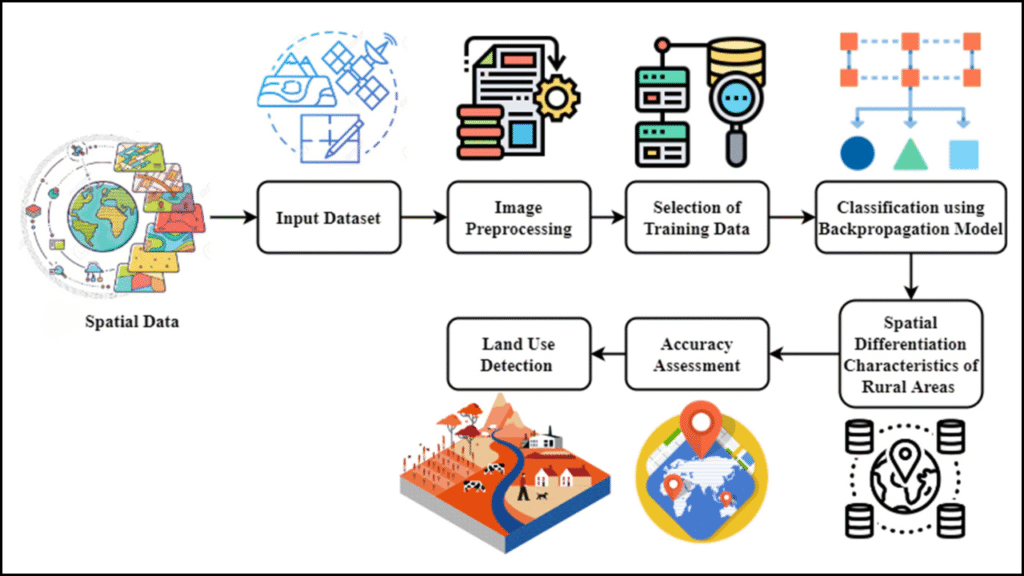
Spatial data has become a cornerstone of modern economic research, offering a new dimension to understanding how geography influences economic behavior, development, and policy outcomes. Economists use spatial data to analyze relationships across locations, such as how proximity to resources, markets, or infrastructure affects productivity, wages, and trade. The integration of geospatial analysis into economics has transformed traditional models, enabling more accurate, location-sensitive insights into development, inequality, and urbanization. This discussion explores how spatial data enhances economic research through improved measurement, visualization, and modeling of spatial relationships.
Table of Contents
Understanding Spatial Data in Economics
Spatial data represents information tied to a specific geographic location, using coordinates or regional boundaries.
Economists employ both spatially explicit data (latitude-longitude points) and spatially aggregated data (districts, states, or countries).
The use of Geographic Information Systems (GIS) and remote sensing technologies allows for precise spatial mapping of economic activities.
Integration of spatial data with demographic, trade, and infrastructure datasets enhances the depth of economic analysis.
Types of Spatial Data Used in Economic Research
Type of Data
Description
Example in Economic Research
Georeferenced Data
Data associated with coordinates or locations.
Mapping household income levels across regions.
Remote Sensing Data
Satellite or aerial imagery capturing land use, vegetation, or pollution.
Measuring agricultural productivity using vegetation indices.
Administrative Boundaries
Spatial data defined by districts, municipalities, or national borders.
Analyzing policy effects across administrative divisions.
Spatial Networks
Data showing connectivity, such as roads, railways, or trade routes.
Assessing the impact of transportation infrastructure on trade.
Raster Data
Grid-based datasets provide continuous spatial coverage.
Studying temperature effects on labor productivity.
Importance of Spatial Data in Economic Research
Enables a precise understanding of how economic outcomes vary across regions.
Helps evaluate the spatial spillover effects of policies, such as tax reforms or infrastructure projects.
Provides insights into regional inequality and urban–rural divides.
Strengthens empirical testing by accounting for spatial autocorrelation, where nearby observations influence each other.
Facilitates visualization of economic dynamics using maps and heatmaps.
Applications of Spatial Data in Key Economic Fields
Field of Study
Spatial Application
Key Insight Gained
Development Economics
Mapping poverty, land use, and access to public services.
Reveals geographic inequalities in development outcomes.
Urban Economics
Tracking housing prices, commuting patterns, and urban sprawl.
Explains how city structure affects productivity and living standards.
Environmental Economics
Linking economic activity with pollution and resource use.
Quantifies the cost of environmental degradation.
Labor Economics
Analyzing migration and employment distribution across regions.
Identifies geographic barriers to labor mobility.
Trade Economics
Measuring trade flows based on transport networks and borders.
Highlights the role of distance and connectivity in trade costs.
Spatial Econometrics and Methodological Advances
Spatial econometrics provides tools to model interdependence between economic units in space.
Models such as the Spatial Autoregressive (SAR) and Spatial Error Model (SEM) capture neighborhood effects.
Spatial panel data combines time and geography, allowing dynamic analysis of growth and policy impact.
Machine learning and geospatial modeling improve the prediction of economic indicators using big spatial datasets.
Key Benefits of Using Spatial Data
Improves policy targeting by identifying local-level needs and disparities.
Enables monitoring of real-time economic activity through satellite-based observations.
Supports disaster risk management and infrastructure planning.
Provides evidence for location-based incentives and regional development programs.
Enhances transparency through public data visualization platforms.
Tools and Technologies Supporting Spatial Economic Research
Tool/Technology
Purpose
Example
GIS Software
Mapping and spatial analysis.
ArcGIS, QGIS.
Remote Sensing Platforms
Satellite imagery for land and environment data.
Landsat, Sentinel, MODIS.
Spatial Statistics Software
Econometric modeling of spatial dependencies.
GeoDa, R (spdep package).
Big Data Platforms
Integration of large geospatial datasets.
Google Earth Engine, AWS Open Data.
Visualization Tools
Presentation of economic results on interactive maps.
Tableau, Power BI, D3.js.
Challenges in Using Spatial Data for Economic Research
Challenge
Explanation
Data Availability
Many developing countries lack high-quality geospatial data.
Measurement Errors
Inconsistent geocoding or boundary definitions reduce accuracy.
Computational Complexity
Processing large spatial datasets requires significant resources.
Privacy Concerns
Detailed spatial data may reveal sensitive information about individuals.
Integration Issues
Combining spatial data with traditional economic datasets can be technically difficult.
Case Studies of Spatial Data Applications
Agricultural Productivity Mapping in Africa: Spatial data from satellite imagery helps measure yield gaps and guide agricultural policies.
Urban Heat Islands in India: Spatial temperature and income data reveal that poorer neighborhoods face greater climate risks.
Trade Corridors in East Asia: GIS mapping of logistics routes quantifies the productivity benefits of cross-border infrastructure.
Disaster Economics in the Philippines: Spatial data supports analysis of how typhoons impact regional economies and poverty.
Spatial Data and Policy Evaluation
Spatial datasets allow researchers to evaluate the local impact of infrastructure projects, schools, or healthcare facilities.
Economists can identify spillover effects, such as improved wages in areas near new industrial zones.
Policymakers use spatial data to simulate how future investments will affect regional growth patterns.
Integration with survey data enables multi-dimensional assessments of development outcomes.
Future Directions in Spatial Economic Research
Increased use of high-resolution satellite data for tracking informal economic activities.
Expansion of spatial machine learning to predict migration, urban expansion, and environmental stress.
Adoption of open geospatial data platforms for transparent policy evaluation.
Integration of climate and biodiversity data into economic growth models.
Development of real-time spatial monitoring systems for global supply chain resilience.
Emerging Research Areas Using Spatial Data
Area
Research Focus
Potential Impact
Climate Economics
Linking temperature and precipitation data to productivity.
Better adaptation policies for climate resilience.
Health Economics
Spatial analysis of disease outbreaks and healthcare access.
Improved allocation of health resources.
Digital Economy
Mapping broadband penetration and digital access inequality.
Promotion of inclusive digital growth.
Transportation Economics
Evaluating spatial efficiency of transport investments.
Enhanced regional integration and trade.
Energy Economics
Locating renewable energy potential using spatial modeling.
Acceleration of sustainable energy transitions.
Policy Implications of Spatial Data Integration
Governments can design region-specific policies rather than one-size-fits-all solutions.
Spatial inequality mapping helps in equitable resource allocation.
Environmental monitoring ensures compliance with emission and land-use regulations.
Spatial analysis aids urban planners in managing congestion, housing, and infrastructure.
Transparency in spatial economic data fosters public trust and informed decision-making.
Parting Insights
Spatial data has revolutionized economic research by providing precise, location-based insights that traditional datasets cannot offer. Geography, long treated as a fixed background variable, now stands at the center of economic analysis. By integrating spatial data with econometric modeling and technological tools, researchers can uncover patterns of inequality, development, and productivity that shape policy decisions. As technology evolves, spatial data will continue to deepen understanding of how local conditions influence global economic outcomes, ensuring more targeted, evidence-based, and sustainable growth strategies.
She is a creative and dedicated content writer who loves turning ideas into clear and engaging stories. She writes blog posts and articles that connect with readers. She ensures every piece of content is well-structured and easy to understand. Her writing helps our brand share useful information and build strong relationships with our audience.